
Published · Updated
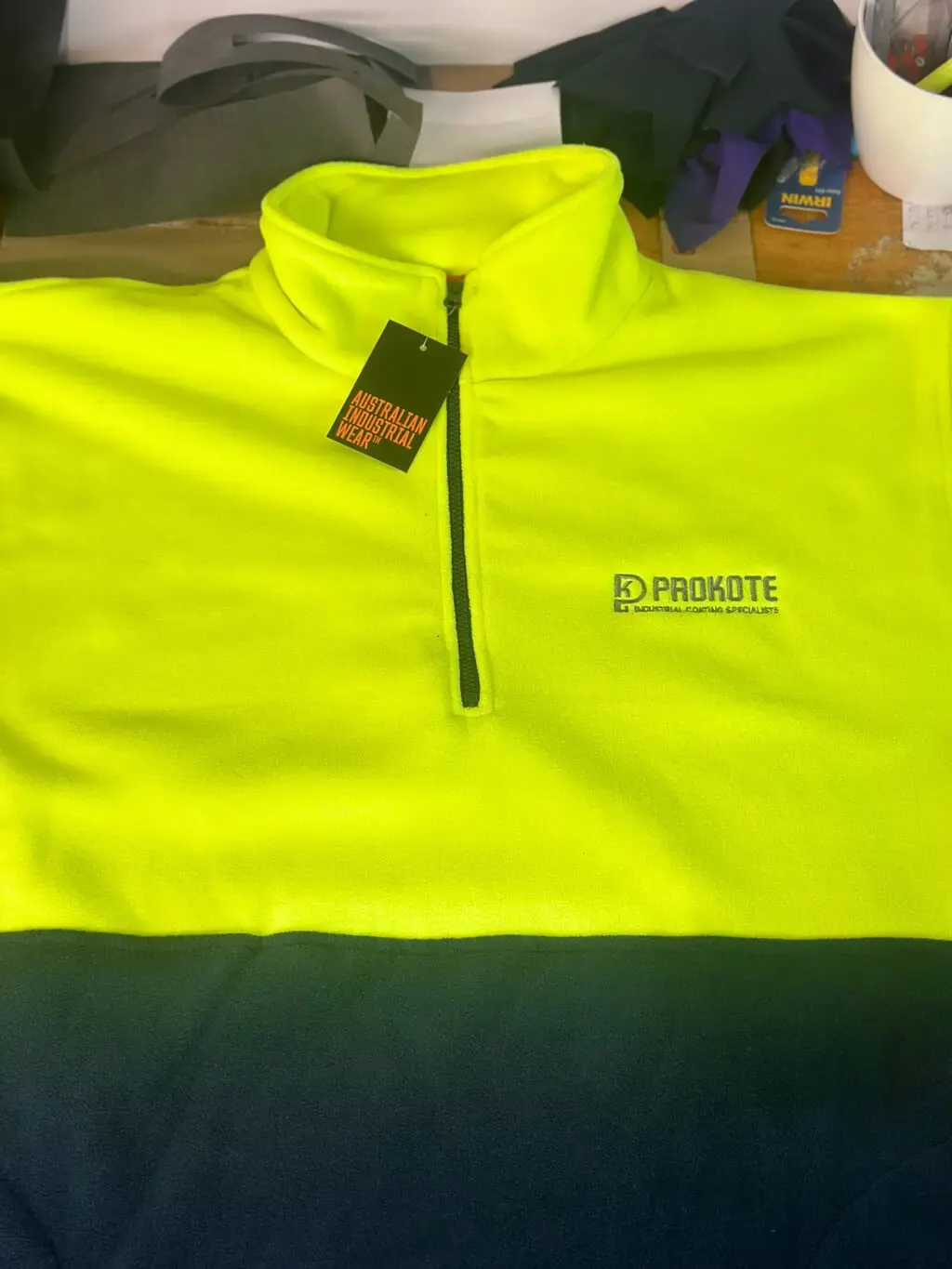
We supply and brand hi-vis for crews of every size at our Unanderra workshop, from a couple of tradies to a whole site team. Getting it right comes down to a few practical choices: the type of hi-vis, the fit, where the logo goes and how you order.
Day or day/night
Day-only hi-vis relies on fluorescent fabric, usually yellow or orange, to stand out in daylight. It suits work that is done during daylight hours.
Day/night hi-vis adds retroreflective tape. The tape reflects light back towards its source, so the wearer shows up in headlights and site lighting. If your crew starts early, finishes late, works near traffic or does night shifts, day/night is the type to look at.
Australian standards cover hi-vis garments for day and night use. Your site, principal contractor or employer may specify the type you need, so check their requirements before you order. If you are not sure, tell us what work your crew does and we will show you the options.
What do Class D, Class N and Class D/N mean on hi-vis?
The class tells you when a garment can be worn. The wording below follows the supplier and Transport for NSW sources linked underneath, and the standard itself is AS 4602.1, published by Standards Australia. The table is as at November 2026.
| Class | Worn | Hi-vis colour required | Reflective tape |
|---|---|---|---|
| D | Daytime only | Yes | Not for night use |
| N | Night only | No, a non-hi-vis colour is permitted | Retroreflective tape gives visibility from vehicle headlights |
| D/N | Day or night | Yes | Yes, both fluorescent fabric and tape |
| N-E | Night, whole-body ensemble | See the standard | Yes |
| D/N-E | Day or night, whole-body ensemble | See the standard | Yes |
Transport for NSW describes Class D garments as designed for daytime use only, and generally ineffective in providing visibility in darker environments. Bisley describes Class N and Class D/N in the same way, and Bunzl Safety lists which classes need a hi-vis colour.
What changed in AS 4602.1:2024?
The standard was republished on 28 June 2024 with new levels and new ensemble classes. Standards Australia lists AS 4602.1:2024 as current. It sets the conspicuity requirements for high visibility garments worn by people exposed to moving traffic, moving plant or equipment in high risk situations, and excludes garments for fire services.
According to Blackwoods, the 2024 edition adds three levels based on the amount and placement of hi-vis material on parts of the body such as the arms and legs, with Level 3 applying to the highest risk environments. It also adds Class N-E (night ensemble) and Class D/N-E (day/night ensemble) for whole-body outfits such as coveralls, or a top and trousers worn together.
Do you need reflective tape for night work in NSW?
On Transport for NSW sites, yes. Its guidance says hi-vis clothing used at night, or in fog, low light or tunnels, must be fitted with retro-reflective strips in accordance with AS/NZS 4602.1. Other sites set their own rules, so check your induction pack. This is why we keep logos clear of the tape, as described below.
Is my AS/NZS 4602.1:2011 hi-vis still OK?
The 2011 Australian edition is listed as superseded, and Standards Australia's store still lists a 2011 amendment as current. We cannot give you a date after which a garment stops being acceptable. What counts on your job is what your site, principal contractor or employer accepts, so ask them before you reorder.
Fit for women and men
Hi-vis that does not fit well is less likely to be worn. Women's fits are cut for a different shape through the shoulders, chest and hips, which matters over a full shift.
We supply women's and men's fits across most of our ranges, so everyone can wear the same uniform in a cut that suits them. Ask each person to check the size chart for the exact garment, because sizing varies between brands.
Keep the reflective tape clear
The tape on a day/night garment needs to stay visible to do its job, so we keep logos on the fluorescent fabric and off the tape.
Spots that usually work well:
- Left chest, above the tape
- Upper back, in the fluorescent area above or between the tape bands
- Sleeves, clear of any tape
Keep the logo a sensible size. A large print covers the fluorescent fabric that helps the wearer stand out. Embroidery works well for chest logos on vests and shirts. For a bigger back print, DTF printing keeps the garment light.
Layering for the seasons
Most crews need hi-vis that works in both summer and winter.
For summer, lightweight hi-vis shirts and polos help people stay cooler. Long sleeves give more sun protection on outdoor jobs.
For winter and wet weather, add hi-vis jackets, vests or rain wear. Whatever is on the outside is what drivers and machine operators see, so the outer layer needs to be hi-vis too. A plain jacket worn over a hi-vis shirt hides it.
If you plan the summer and winter garments together, the whole crew stays matched all year and your logo sits in the same place on every layer.
Ordering for a team
A few steps make a team order go smoothly.
- Collect sizes from everyone before you order, including whether each person wants a women's or men's fit.
- Choose the garments for each season up front, so the crew matches.
- Order a few spares in the most common sizes for new starters and replacements.
- Keep a record of the garment styles, colours and logo placements, so reorders match the first batch.
Most orders are completed within 10 business days. If you have a project start date coming up, let us know when you enquire.
Browse our workwear and PPE range, or call 02 4228 3508 to talk through what your crew needs.
Common questions
What is the difference between day and day/night hi-vis?
Day-only hi-vis uses fluorescent fabric, usually yellow or orange, to stand out in daylight. Day/night hi-vis adds retroreflective tape, so the wearer can also be seen in headlights and site lighting.
Where should a logo go on a hi-vis garment?
Place the logo on the fluorescent fabric, such as the left chest above the tape or the upper back, and keep it off the reflective tape. A modest logo size leaves more of the hi-vis fabric showing.
Do you supply hi-vis in women's fits?
Yes. HTG Group supplies hi-vis in women's and men's fits across most of its ranges, and brands them in-house with embroidery or DTF printing.
What hi-vis is best for summer on outdoor jobs?
Lightweight hi-vis shirts and polos help people stay cooler in summer. Long sleeves give more sun protection on outdoor jobs. Plan the summer and winter garments together, so the crew stays matched and the logo sits in the same place on every layer.
Does a jacket worn over hi-vis need to be hi-vis too?
Yes. Whatever is on the outside is what drivers and machine operators see, so a plain jacket worn over a hi-vis shirt hides it. For winter and wet weather, add hi-vis jackets, vests or rain wear. We brand the outer layers in-house with the logo in the same position as the shirts.
What do Class D, Class N and Class D/N mean on hi-vis?
Class D is for daytime use only. Class N is for night use only, where the reflective tape does the work, and a non-hi-vis colour is permitted. Class D/N is for day or night use and needs hi-vis colour plus reflective tape. Whole-body ensembles are classed N-E and D/N-E.
What changed in AS 4602.1:2024?
Standards Australia published AS 4602.1:2024 on 28 June 2024. It supersedes AS 4602.1:2011, adds three levels based on how much hi-vis material is on the arms and legs, and adds Class N-E and D/N-E for whole-body ensembles. Level 3 applies to the highest risk environments.
Do you need reflective tape for night work in NSW?
For work at night or in low light on Transport for NSW sites, its guidance says hi-vis clothing must be fitted with retro-reflective strips in line with AS/NZS 4602.1. Your own site or principal contractor may set stricter rules, so check their requirements.
Is my AS/NZS 4602.1:2011 hi-vis still OK?
The 2011 Australian edition is now marked as superseded by Standards Australia, as at November 2026. Ask your site, principal contractor or employer which edition they accept before you order, because we cannot tell you what a particular site will allow.